

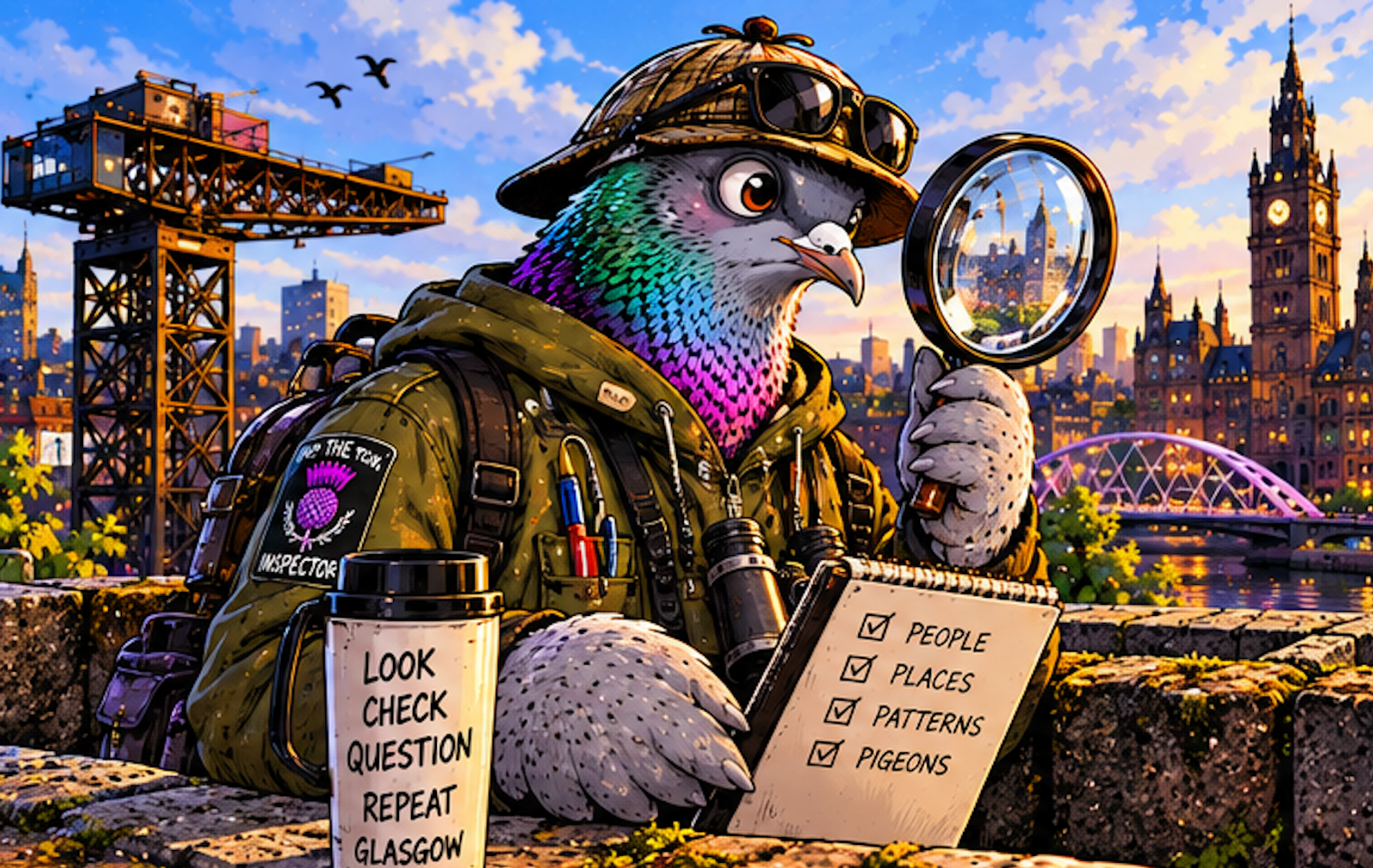
From the edge of the hoardings, The Inspector has been conducting a long-term experiment.
The hypothesis is simple: if Glasgow digs up enough of the city centre at the same time, does everybody eventually stop asking when it will be finished and simply accept the cones as a native species?
Results remain inconclusive.
Because here is the annoying thing.
The bits you can actually see now are good.
Properly good.
Where sections of the new streetscape have opened, people can finally stand on it, walk through it, sit beside it and see what all those glossy council videos were trying to explain. Suddenly the CGI trees and impossibly relaxed pedestrians make a bit more sense.
You can see the shape of the thing.
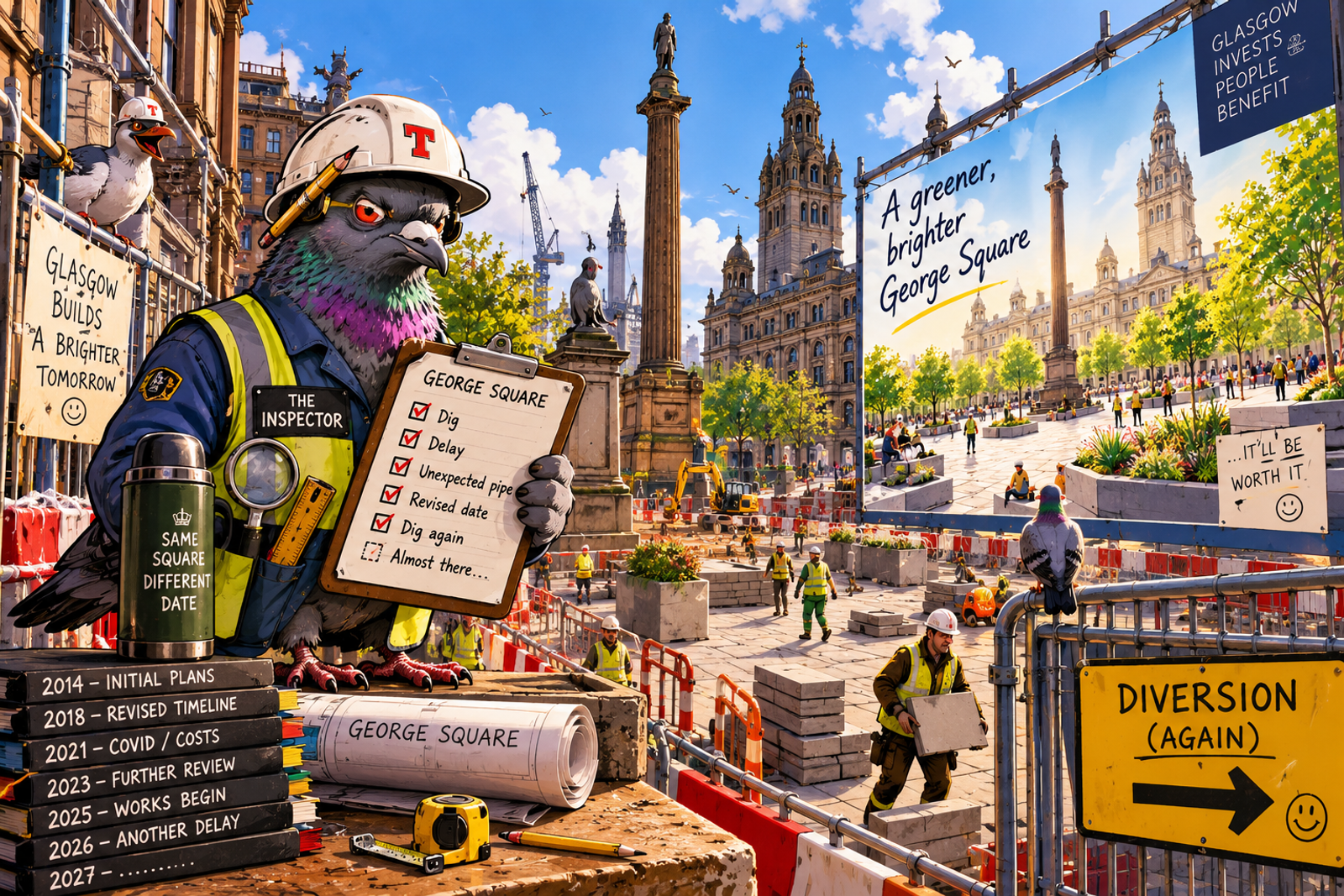
You can imagine George Square without the fencing, the surrounding Avenues joined up, the paving finished, the greenery grown in, the statues back where they belong and nobody having to interpret a temporary pedestrian diversion written by someone who apparently thinks humans navigate by magnetic field.
That is progress.
It is just taking its time arriving.
George Square has already had its dates moved around more than once. Earlier council plans pointed towards a spring 2027 completion, while the wider programme has also been reshuffled as procurement, costs and neighbouring Avenue works have changed.
And, to be fair, some of the reasons are perfectly understandable.
Glasgow is an old city. Put a shovel into it and there is every chance you will discover a pipe nobody remembers installing, a wall that does not exist on any drawing, some Victorian engineering that has been quietly doing its job since Queen Victoria still had a pulse, or a hole where everybody had been confidently assuming ground.
You cannot really blame a modern project manager for infrastructure last updated when cholera was still considered a neighbourhood feature.
The Inspector accepts this.
He has written it down.
Twice.
The problem is that Glasgow has reached the stage where every explanation arrives carrying another traffic cone.
George Square is being rebuilt. The Avenues are marching through the city centre. Roads have been shut or narrowed for major works. The Commonwealth Games brought another layer of temporary closures and changes. Glasgow has spent recent years collecting fires, emergency works and sinkholes with the enthusiasm of a city trying to complete an urban-disruption sticker album.
At some point you start wondering whether the official city-centre bird should simply be a diversion arrow.
And yet, annoyingly, The Inspector can see how this ends.
That is what stops him becoming properly grumpy about it.
One day the barriers will disappear.
The machinery will go.
The Square will be open, the planting will have settled in, the Avenues will connect properly and people will start using the city centre as though it had always looked like that.
Within months, the complaints will change.
Nobody will remember precisely which bit opened three months late or which utility line held everybody up for another fortnight.
Someone will sit outside with a coffee and say, “This is lovely. They should have done this years ago.”
That is how cities work.
We remember bad public spaces for decades and construction disruption for about fifteen minutes after the last fence comes down.
So yes, Glasgow probably will forgive all of this.
Probably quite quickly.
The Inspector can already picture the final result, and for once he is willing to admit it looks rather good.
He would just quite like to see it before somebody discovers another bloody pipe.