

The Fan has barely stopped talking since Saturday, mainly because there has been no sensible point at which to pause.
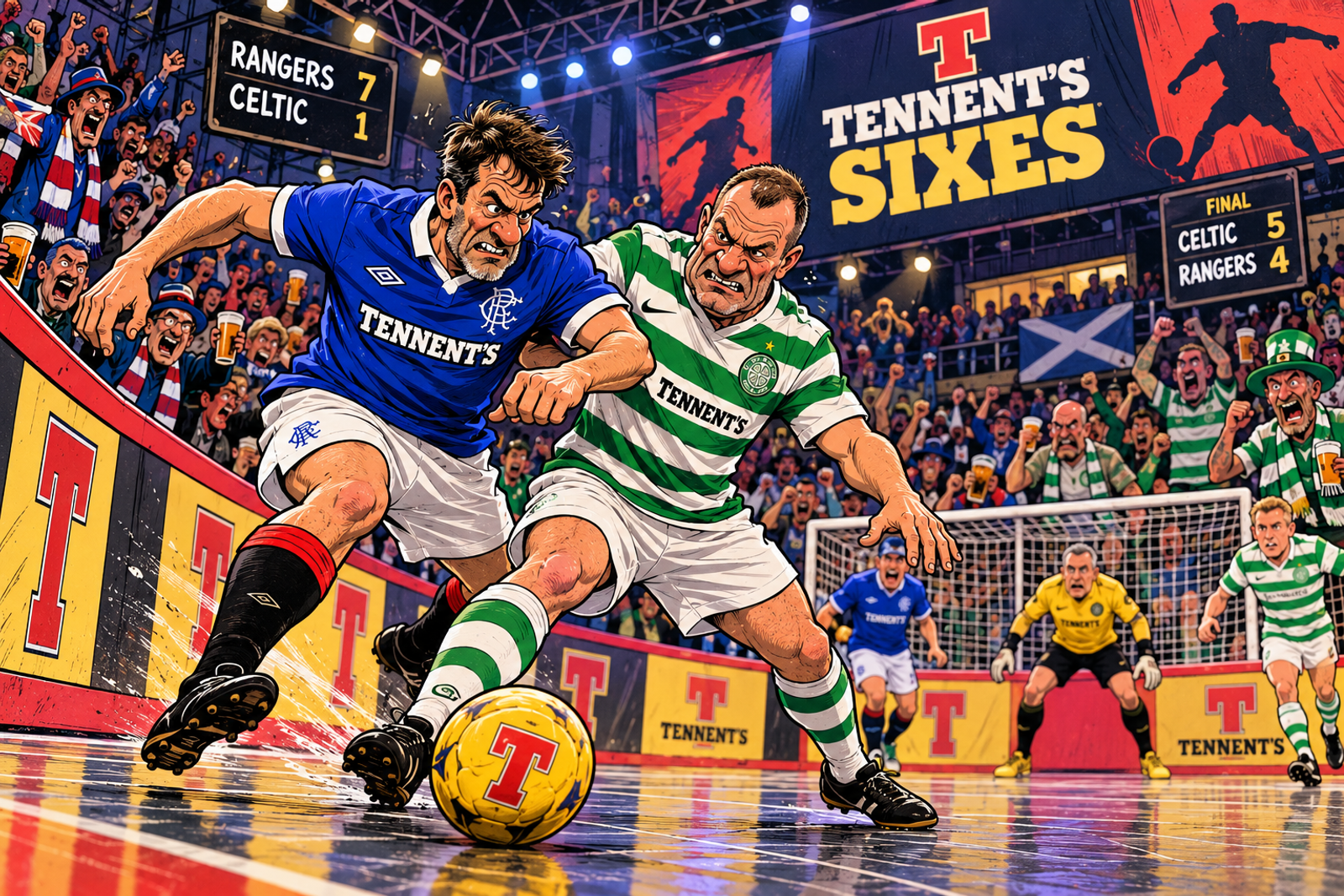
The Tennent’s Sixes came back after 33 years, Braehead put the boards up, the old shirts came back out, and within what felt like five minutes Rangers were 7–1 up on Celtic and half of Scottish football had suddenly become Johan Cruyff with a group chat.
Seven-one is the sort of scoreline that does not just sit there quietly. It starts breeding screenshots. It acquires captions. Somebody’s uncle decides it definitely counts as a proper derby because there was a referee and a scoreboard and, technically, everybody had socks on.
The Fan had barely finished enjoying the chaos before the whole thing turned itself inside out.
Because Celtic met Rangers again in the final and won 5–4.
Same weekend, same teams, completely different ending.
That is Scottish football in one neat little indoor box. You can build an entire cathedral out of a 7–1 result on Saturday and spend Sunday watching the other lot walk off with the silverware while you are still arguing about the stained glass.
This is why The Fan does not trust football.
It is also why he loves it.
The Sixes were never really about importance. That was the trick. They were about taking the beautiful game, ripping away the bits where everyone gets time to think, shrinking the pitch until dignity becomes optional and seeing what happens when very good footballers are denied the luxury of pretending they have all afternoon.
There is no gentle recycling through the centre-halves. No full-back wandering into a half-space while somebody on television says “they are asking questions”. No five-minute spell where everyone resets shape and waits for the next pattern of play.
You get the ball and somebody is already on you.
The boards are alive, bad passes become attacking opportunities, ricochets turn into assists, and every first touch has consequences. The whole thing moves with the twitchy urgency of a five-a-side game where one team has been told the pitch is closing in ten minutes.
That is where The Fan comes alive.
He loves the way the old instincts are still there even when the legs have started negotiating separate employment contracts. He loves watching a retired player shape to bend one into the corner and, for half a second, everyone in the building forgets knees, mortgages, coaching badges and hamstring history.
For one moment, the body catches up with the memory.
Then somebody tries another burst and the illusion collapses near the advertising boards.
Beautiful.
The Sixes have always had that feeling. It is football with the paperwork stripped out. Quicker, tighter, slightly more unhinged and somehow even more Scottish because nobody involved seems capable of treating it casually.
And once you add the Old Firm into that little pressure cooker, the nostalgia disappears very quickly.
The grudges are still fully charged.
That is what makes Rangers hammering Celtic 7–1 and then losing 5–4 to them in the final so wonderfully ridiculous. It should not make emotional sense. It makes perfect football sense.
One result tells you everything until the next one happens.
That is the game.
Not neat narratives. Not fairness. Not logic.
Momentum, touch, panic, muscle memory, bad decisions, good finishes and one bloke still absolutely convinced he has another yard in him because he remembers having one in 2009.
By Sunday night, Celtic had the trophy, Rangers had somehow managed to turn a 7–1 win into part of a losing weekend, and Scottish football had remembered something it had misplaced for three decades.
The Sixes do not need to matter.
They just need to feel like football.
Fast, daft, competitive, slightly dangerous to ageing hamstrings and completely impossible to ignore.
The Fan wants it back next year.
Preferably immediately.